Showing posts with label Aircraft. Show all posts

Monday, November 24, 2014

A320 v 737: the sales winner is….

It’s one of the bitterest rivalries in the industrialized world: Airbus vs Boeing.

Despite being world-class companies, executives at each often snipe
at each other’s airplanes, claiming superiority in economics and
passenger appeal. Like lawyers arguing a court case, data is typically
selectively used to advance the claims.

One of the most hotly debated issues between the two companies is
which is the best single-aisle airplane, the ones that fly the most
routes in the world and which carry more passengers than any other type:
the Airbus A320 or Boeing 737 families.

Boeing’s marketing and communications team has done a superb job of
claiming its 737 is the best selling jetliner of all time and with
12,257 firm orders since the first program, the 737-100/200, was
launched in 1964. The 737 edges out the A320 family’s 11,021 orders.
(These figures exclude options and MOUs.)

But the A320 was launched in 1984, 20 years after the 737. A even-up
comparison should begin in March 1984 comparing the A320 family with the
737 Classic from then to the end of the Classic’s production run; and
with the 737 Next Generation from its program launch in November 1993;
followed by the A320neo and the 737 MAX.
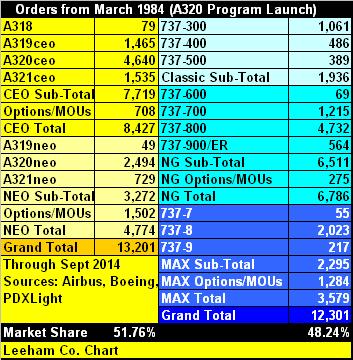


From
March 1984 when Airbus launched the A320 through September, the
European airplane has sold more airplanes than Boeing has sold the
various 737s during the same period. Both companies have announced
hundreds more orders since October 1. Click to enlarge.
When the count is adjusted to start from the A320’s program launch,
Airbus can correctly claim it has sold more A320 Family members than
Boeing has sold 737 Classics, NGs and MAXes over the same period.

The 737, which entered service in 1968, had a solid customer base
built up in the 16 years before Airbus launched the A320 program in
March 1984. The so-called 737 Classic (300/400/500) is no longer in
production, having been superseded by the 737 Next Generation (NG),
launched in November 1993. The NG and the ceo are still in production.
Coming from nowhere, with no customer base, Airbus captured 47.5% of the
firm orders and 48.9% of the firm orders plus options, letters of
intent and memorandums of understanding.

Airbus launched its re-engined A320neo (New Engine Option) in
December 2010. Boeing launched the 737 MAX. the following July. These
each come in three sub-types. Airbus is the runaway-market winner.

Boeing points out that Airbus had a seven month head-start on program
launch and claims that since the MAX was launched, it’s won 50% of the
campaigns. The website PDXlight.com provides an independent look at sales in the days since launch; the A320neo consistently outsells the 737 MAX.

The first of the A320neos is scheduled to enter service in October
next year. The first 737 MAX is scheduled to enter service in July 2017.

Boeing’s dominance in the single-aisle is a thing of the past, and it
won’t return for at least another decade and perhaps a decade and a
half—certainly not until Boeing designs an entirely new, “clean sheet”
airplane and this even depends on the Airbus response.

Boeing CEO Jim McNerney, asked about the market share on the third
quarters earnings call Oct. 22, maintained Boeing’s long-running
statements that it will recover to obtain a 50% share of the A320-737
market.

Airbus’ isn’t concerned about the prospect of a Boeing NSA, or New
Single Aisle airplane. Kiran Rao, Airbus’ executive vice president of
sales and marketing, and John Leahy, chief operating officer-customers,
said on several occasions that there won’t be enough technological
advances in engines and airframes to support a new, clean sheet airplane
before a 2030 entry into service, or EIS. It’s possible that by 2025 an
NSA could be designed and into service with 25%-30% lower operating
costs than today’s A320s and 737s. But if the benchmark is changed to
the new A320neo and 737 MAX, each predicted to be 14% better than
today’s airplanes, there is a huge challenge to achieve 25% or better by
2030, let alone 2025. It can’t be done by the earlier date, Rao and
Leahy say.

“We’re comfortable with the A320neo,” Rao says.

Boeing claims its 737-800 and successor the 737-8 are about 8% more
economical per seat. Airbus makes counter-claims, but airlines that
evaluated the planes and some that operate both the A320ceo and 737NG
say Boeing has an operating cost advantage of only 2%. But customers,
whose opinions count far more than the hype promulgated by Airbus and
Boeing, say the A321neo is a superior airplane to the 737-9 and sales
figures support this.

On Oct. 21, Airbus upped the ante. Airbus confirmed to the on-line newsletter Leeham News and Comment that it now is offering an A321neo high gross weight that will replace the Boeing 757-200
on 3,900nm routes that are too “thin” for long-range twin-aisle
airplanes like the Airbus A330 or Boeing 787 that carry twice the
passengers of the 757. Boeing’s 737-9, with a basic design dating to the
1960s, can’t be further developed to match the new A321neoLR (Long
Range).

The A321neoLR will further marginalize the 737-9.

At the low end of the Airbus and Boeing offerings, the smallest
A319ceo and 737-700 on their last legs. There have been few recent sales
and the backlog for each is winding down as deliveries are made. Their
replacements, the A319neo and the 737-7, are largely regarded in the
industry as placeholders, rear guard action to serve as a road-block, if
one is needed, against the new, clean-sheet 135-seat Bombardier CS300
and Embraer 122-seat E-195 E2. The strategy is more illusionary than
real. There are more than 180 firm orders for the CS300 (EIS late 2015
or early 2016) and 50 for the slightly smaller E-195 E2; the latter is
still in its infancy, with an EIS of 2019. There are just 49 orders for
the A319neo (EIS 2017) and 55 for the 737-7 (EIS 2019). There are two
identified customers for the A319neo, Frontier Airlines and Columbia’s
Avianca, and 12 orders listed as Unidentified customer(s). Frontier is
transitioning to an Ultra Low Cost Carrier and will likely opt for the
larger A320neo or even the A321neo, the largest member of the family.
Avianca needs the hot-rod performance of the high-powered, light-weight
A319neo for its South American service and will probably take the order.

The 737-7, on the other hand, is problematic. Southwest Airlines in
the USA has 30 on order and Canada’s Westjet the other 25. When the time
comes to “cut metal” about 2018, it’s quite possible each will upgauge
to the larger 737-8.

This leave Boeing in quite the quandary: a 737 MAX family with a good-selling -8, a non-existent -7 and a poor selling -9.

At the October European conference of the International Society of
Transport Aircraft Traders, a poll was taken of the 1,200 delegates
asking if Boeing or Airbus had the more competitive single-aisle
airplane. Fifty percent of the audience voted for Airbus; just 23% for
Boeing. It’s quite the comedown for the proud Boeing.

Airbus has neatly mouse-trapped Boeing.


Copyright © 2014 · All Rights Reserved · Leeham News and Comment


Tuesday, August 26, 2014

Updating the A380: the prospect of a neo version and what’s involved

Recent headlines and this column report that Airbus is considering
re-engining the popular A330 with GE Aviation GEnx or Rolls-Royce Trent
1000-TEN power plants. A New Engine Option and other changes would
improve the A330’s economy by an estimated 10% percent after offsets for
increased drag and weight.

But the A330 isn’t the only Airbus airplane being considered for new
engines made popular by the A320neo family. Tim Clark, president and
chief operating officer of Emirates Airlines, urged Airbus to improve
efficiency of the giant A380 with engine technology found in newer
generation aircraft.

How feasible is an A380neo? What are the technological issues? Would
there be enough of an economic gain? And is there a market for an
A380neo?

The A380 of today

The A380 has been hailed as a highly efficient airliner since it went
into service 2008, assuming the giant plane can be filled. But only six
years later, the first voices have been raised that this will not
continue to be the case should the continuous improvements that have
been flowing into the airframe not pick up speed.

The launch of the Boeing 777X also brought focus on the state of the
A380 come the latter part of this decade when the 777-9X enters flight
testing in advance of its planned 2020 entry-into-service. Tim Clark
expressed  that “it is time that the A380 gets an injection of the new
technology which is now becoming available for the A320/737 in the form
of GTF/LEAP and GE9X for the 777X. “

Before we look into what can be done short-to–mid-term to inject
improved efficiency, let’s establish the baseline as it exists today.
The A380 is considered by some the most efficient way of flying
passengers between two long haul points if there is enough of demand.
The competition today is the Boeing 777-300ER and 747-8i.  (Qantas
Airways is dropping some A380 flights that have 50% load factors,
demonstrating the aircraft is inefficient if the demand is
insufficient.)

Let’s assume we want to transport passengers between San Francisco
and Hong Kong, one of the longer flights which are made non-stop in both
directions. Going West, it takes a Cathay 777-300ER 15 hours and going
East, 12 hours, the difference being due to prevailing headwinds going
West. For our check, we will use the more demanding of these legs, which
then works out as the equivalent of flying 7,200nm. To compare the
three different aircraft in a fair way, we need to load them to the same
payload, in our case passengers with luggage. We will not consider
cargo in this initial analysis. The leg chosen is not one which allows
much weight for cargo, but cargo certainly belongs to a complete
analysis of an airplane and we will point out where it will affect any
conclusions.

When comparing the standard three-class seating numbers between the
OEMs, it is clear these are not made to the same standards of comfort.
Airbus has admitted that the A380 is too lightly loaded at 525
passengers. The 777-300ER at nine abreast and 365 seats is equipped with
a comfortable 18’’ economy class at 32’’ pitch but the business class
is modeled with a non-standard 48’’ pitch. The 747-8i at 467 seats is
not laid out to any comfort standards comparable to the other two. To
ensure an apples-to-apples comparison we have equipped all aircraft with
the same three-class cabin with a standard seating consisting of first
class at 81’’ pitch, business class at 60’’ pitch and economy class with
32’’ pitch. Seat widths are 37’’, 22’’ and 18’ respectively and the
ratios of the different premium seatings vs. economy are kept the same.
Here the aircraft are listed with the in-service year and with their
respective payload capabilities:

Click on all illustrations to enlarge.

A380 v 777 v 747-8 specs
Table 1

Today’s costs

Fuel constitutes about 50% of long-haul costs; therefore we will
focus on this main cost parameter for this comparison between the
aircraft. In the table below we have now added the trip fuel burn over
our chosen 15 hour flight. Since we compare aircraft of vastly different
sizes, our normal cost per aircraft mile comparison makes little sense.
We have kept the fuel cost per available seat mile and complemented
with the format that Lufthansa uses: litre consumed per passenger and
100km flown. (These figures represent nominal aircraft with our
standardized cabin. The figures therefore cannot be compared with the
Lufthansa published litre fuel/100km, which is for aircraft with their
specific seating):

A380 v 777 v 747-8 economics
Table 2

As can be seen, all aircraft are in the same fuel cost range with the
A380 having 5% worse fuel costs per seat than the 777-300ER but 3%
better than the 747-8i. The differences in direct operating costs are
augmented by the 300ER’s lower engine maintenance costs and the revenue
side has a superior cargo capability.  Why, then, does Emirates tout the
A380 as its premier aircraft? Because for an airline, an aircraft is
judged in part by the difference between Revenue per Available Seat Mile
(RASM) and Cost per Available Seat Mile (CASM). Emirates has passenger
load factors which are considerably higher for the A380 than other
aircraft. This more than compensates for any difference in fuel burn,
cargo capacity (cargo pays less well than passengers) and engine
maintenance cost. This is valid as long as the fuel consumed per seat
mile does not differ more than today.

If we look forward to the turn of the decade and introduce the 777-9X
into the table, it is clear why Tim Clark is now saying the A380 will
have to be updated come 2020. The new 777-9X will consume 20% less fuel
per seat then the -300ER, according to Boeing, and then the cost
equation will change.

A380 v 777 v 747-8 v 777x economics
Table 3

The 777-9X has a 13% better fuel consumption per seat then today’s
A380. Add to that its 27 empty LD3 positions once the baggage LD3s have
been loaded and the business case for a A380 is getting challenged.  It
shall be noted that we now have the economy section for the 777X at 10
abreast, which is below our 18’’ seat-width rule. Should we have kept
this rule, the per seat fuel difference would have been -8%. Given the
small comfort improvements that -9X brings for 10 abreast economy—an
increase of about one-half inch per seat, Boeing calculates—and the
likelihood that most airlines will fly it at 10 abreast, we therefore
show the upcoming threat to the A380 as a 10 abreast variant (already
nearly three quarters of the airlines today go 10 abreast for the
-300ER).

Updating the A380

As can be seen, the enhanced A380 should be available in a new
version before or around 2020. There are principally three ways Airbus
can prepare the A380 for the next decade:

  1. Rely on incremental improvements to engines and aerodynamics and make the cabin denser;
  2. Update to engines available before 2020, improve aerodynamics and make the cabin denser; or
  3. Update to engines available after 2020, improve aerodynamics and have more freedom with cabin density.
Of these improvements, we will discuss the aerodynamic improvements
and denser cabins first since these are common factors for all three
alternatives.

The A380 is a construction of a somewhat different shape compared to a
classical “wings with tube” airliner. This is a result of wanting to
transport up to 800 people in a vehicle which is constrained to a
maximum dimension of 80 meters by 80 meters for airport operations, the
famous 80 meter box. This forced Airbus to build the A380 with a two
stories fuselage and with a wing with an unusually low aspect ratio. At
7.8, it is well below the present state of the art, which is more like
9.0 (777-300ER) or 9.5 (787, A350). The drag due to weight (induced
drag) is therefore higher than normal. This is compensated by good
values for the normally dominant drag component, the drag due to size
(wetted area and form drag). In fact, the figures for drag show the
reverse trend compared to normal airliners with drag due to weight
dominating with 50% at average cruise weight and the drag due to size
down at 40%. Thus the A380 compensates a restricted wing with good
packaging of the passenger compartment. Its short two-story passenger
compartment and elaborate main landing gear restricts its cargo
capability however, something is shares with the 747-8i.

Aerodynamic improvement to reduce induced drag is therefore a primary
goal for any A380 update. It will take the form of wingtip treatments
to increase the effective span. As the wing is already at maximum
possible span and was not designed for folding wing-tips, the remaining
option is large winglets that spread in the vertical domain. These can
take the form of single blade (Sharklets) or multi-blade (Scimitar or
perhaps “Sharkfins” in Airbus parlance) devices that alleviate induced
drag as a function of their physical size. We have assumed winglets of
4m size in our analysis, which enhance the efficiency by 3.5% over the
present wing fences on long-haul flights.

To get more revenue generating passengers on board, Airbus is
studying 11 abreast seating on certain parts of the A380 main deck. This
will increase the coach capacity by about 30-40 seats without
compromising the 18’’ seat width standard, according to the company. We
will include such a denser cabin when we compare future A380 variants to
today’s aircraft.

New engines

We will now examine the perhaps most important component of an
efficiency improvement program for the A380, the engines (see table
below for a list of all candidates):

A380neo Engine Specs
Table 4

First the incremental improvement of the existing Trent T900 and
EA7200. The T900 has historically trailed the EA7200 by about 1% in
specific fuel consumption. The present T900EP is said to close that gap
and Rolls Royce have another improvement package in the works which will
add another 0.8%, T900EP2. The size of these improvements are typical,
about 1% every three years; thus we would expect to see a total of 2%
improvement from now to 2020.

A second alternative is to take an existing engine from a later
generation. Suitable engines in thrust and weight would be 787 engines,
the GE GEnx-1 and Rolls Royce T1000. These deliver an improvement of
4%-5% over the present A380 engines in the variants that are being
developed for the 787-10. With these engines being certified in 2015,
theoretically an A380neo can see an EIS in 2016, sooner than a new
engine could be engineered onto the A380. A more likely A380neo target
EIS would be 2018, the wish date of Emirates for an upgrade (the airline
starts to take delivery of the new batch of 50 then). The 787 engines
are some 250kg lighter then the lightest A380 engine (T1000) and as they
have less fan diameter their nacelles will be slightly smaller and
lighter.

A third alternative would be a totally new development based on e.g.
RR RB3039 or a PW GTF. Such engines offer an additional 6%-7% efficiency
improvement over a 787 engine derivative. Their drawback would be
higher weight and drag due to their larger fans and their 60:1 pressure
ratios. Another drawback is that they will not be available until after
2021. Additionally there is the question whether there is a business
case for an entirely new engine serving only the A380, a niche aircraft
for which the 20 year market demand before or after a neo is a matter of
diverse opinions.

The different engine alternatives are shown in the table where we
have also included the A330 engines as the thrust requirement for an
A330neo is similar to the A380 and there is a certain probability that
development of an engine variant and nacelle would be shared between the
two programs (Table 4).

There is a lack of an entry from PW in the table, mainly because it
has not publicly presented the outline of an alternative. For a 2021
time frame, PW could well be in the running. The question would then be
with what programs could they share the development costs as a re-engine
of the A380 would potentially only represent a small number of engines
for PW. It can also be seen in the table that GEnx-1 somewhat trails the
T1000-TEN in efficiency, mainly because Rolls Royce have decided to do
three updates of the T1000 and GE have only announced to be doing two.
It would be no big problem for GE to inject some LEAP technology into
the GEnx-1 for an A380/330 neo project and close that gap.

Much has been written about the work involved in converting 787
engines to bleed variants. In fact these are bleed engines. These
engines put out compressor bleed air to deice the nacelle inlet and they
use compressor bleed ports to correct compressor handling problems at
low RPM. In essence bleed variants are rescheduled variants of the
existing engines, not a big redesign as many speculate.

Which way to go

If we put the three alternatives on the A380 and list them side by
side with the present and future Boeing competitor we will get the
following table:

A380neo v A380ceo v Boeing
Table 5

There are a number of conclusions that can be drawn:

A380-PIP

Airbus can almost achieve Emirates wish for a 10% improvement in
efficiency per seat until 2018 with a combination of 11 abreast economy
cabin on the main floor, improved aerodynamics and incrementally
improved engines. This variant would beat the 777-300ER in per seat
efficiency as long as a 300ER runs at nine abreast. If we change this to
10 abreast, the 300ER passes the A380-PIP with 3%. It shall once again
be pointed out that we only look at passenger capability here.
Under-floor cargo is the 777’s strong point and it will improve the 777s
earnings in a real situation. The A380-PIP would not match a 777-9X in
per seat efficiency but it would be within 4%, both using denser cabins
than today. Once again higher cargo capability will improve a 777X
business case, especially if seasonal fluctuations reduce the A380 load
factors over, for example, winter months.

A380neo16

With an additional upgrade to 787 engines we gain another 5% in trip
fuel burn and therefore also seat fuel burn as all improved variants
share the denser cabin. This variant is fractionally more efficient than
a 777-9X and would be attractive for routes where one can fill an A380
also after 2020. There is no projected aircraft that can reach the per
seat economics of a well loaded A380neo16, and this is what Emirates
route planners have found.

A380neo21

If the engine upgrade of the A380 would wait for Rolls Royce or PW
engines of the 777X generation (GE might be restricted by its 777X
engagement, see A350 engine sharing problematic below), it would gain
another 5% in fuel economy over the A380neo16 variant. While this is
attractive it has more complicated project and business model
implications. The A380 is not a high volume program and it is not
projected to be for the 20 years remaining after a neo. It would thus at
best create a market for an engine program of some 2,000 engines, or
roughly 400-500 airplanes, plus spares. Should this be divided between
two manufacturers like today, we talk about 1,000+ engines per engine
program. Given the uncertainty of A380 sales numbers this is not a
viable business case for a new engine development; costs would have to
be shared with some other platform.

Finally:

Sharing with an A330neo is ideal as the A330 and A380 have the same
thrust requirements. It is doubtful an A330neo can wait until 2021,
however, due to market pressure—EIS is being discussed for 2018. This
leaves the A350 as a partner program for an A380neo21. Here, the thrust
and therefore engine size requirements do not fit well. A new engine for
A350 should ideally cover 80-105klbf as an A350-1100 is a likely
development. Detuning an engine designed for 100klbf by 25% results in a
substantial loss of efficiency, both in terms of specific fuel
consumption and size/weight. The A350 is also constrained as to which
models GE and PW can be allowed to bid for; only Rolls Royce would have
access to all variants due to their A350-1000 exclusivity. In summary an
A380neo21 is less straight forward then an A380neo16 with higher
investments and risks for the engine manufacturers.

Finally, we note that none of these analyses consider the prospect of
a stretched A380, the -900. Airbus does not seem in a hurry to define
such a development. We therefore focused on updates to the existing -800
model.

The best Return on Investment for the engine makers is a common
engine on the A330neo and the A380neo, and the timeline desired by
Airbus for the A330neo all but dictates a choice of the GEnx or Trent
1000 TEN, with the resulting application to the A380neo.

Our data, and analyses by customers who have evaluated the 777-9 vs
the A380 (and 747-8i), indicate a 10-abreast 777-9X has better seat mile
costs then the much larger, current A380 and the 747-8i. Thus, if
Airbus is going to maintain an economic advantage with its four engined
airplane vs the twin-engine 777-9, an A380neo is a must.

By Leeham Co EU

 | Leeham News and Comment

The Super Twin Battle: A350-1000 versus 777-9X

With the forthcoming launch of the 777-9 at the Dubai Air Show next
month, the battle between the A350-1000 and 777-9 will be officially on,
with two very different aircraft competing for the same market.  While
there is discussion of another stretch to the A350 program to provide
comparable capacity to the larger 777-9, we can compare today’s aircraft
and examine their relative economics based on manufacturer projections
and Piano models based on preliminary specifications.

The A350-1000

The A350-1000 is the largest of 3 models in the A350 family, with 350
seats in a typical three class configuration, with an 8,400 nautical
mile range.  The A350 features carbon fiber composite structure and
wings, and at 53% composites will have slightly more of the aircraft
made of this material than the Boeing 787-9, which is 50% composites. 
It features new technology Trent XWB engines from Rolls Royce with
state-of-the art fuel efficiency, advanced aerodynamics, and state of
the art systems.

The 777-9X

The 777-9 is a stretched version of the current 777-300ER with a new
engine and new wing, along with other enhancements, to create an updated
version of the 777, which delivered its 1,000th example earlier this
year.  The 777-9X will feature an aluminum alloy fuselage with a carbon
fiber composite wing, and new technology GE9X engines that are derived
from the GE90 and GEnx families.  The wingspan for the 777-9 will be
longer than any Boeing aircraft, and will include folding wingtips to
enable the aircraft to utilize current gate positions at airports, as
otherwise the new model would require gates typically used for A380
operations (which are currently quite limited at congested airports.)

Comparing the Aircraft

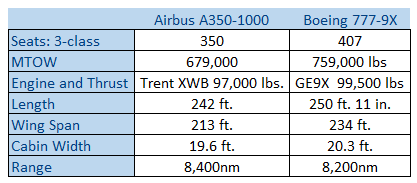
The following table compares the two aircraft on several key statistics, based on preliminary data prior to the 777-9X launch:

The A350 cabin width is larger than the 787 and smaller than the
777X.  The result is that a typical configuration in economy would be 9
abreast at 17 inch seat width for the 787, 9 abreast at 18 inch seat
width for the A350, and 10 abreast using 17 inch seat width for the
777.  While the 777 is currently offered in 9 and 10 abreast seating,
recent orders have trended to 10 abreast seating as airline seek to
maximize seat-mile costs.

10_28_2013_11_55_45_AM
COMPARATIVE ECONOMICS

Both manufacturers are claiming class leading economics for their
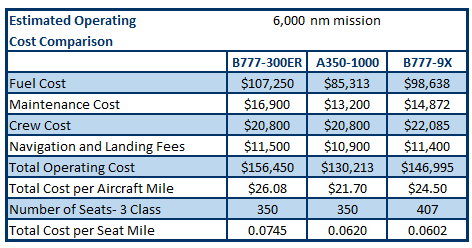
airplanes, but in reality, they are very, very close.  The 777-9 holds a
16% advantage in capacity, which directly impacts seat-mile costs, but
the A350-1000 will have lower trip costs than its larger competitor. 
Our estimates for a 6,000NM trip, based on preliminary specifications
from airframe manufacturers, our own economic modeling, and data gleaned
from airlines, are as follows:


10_28_2013_11_54_53_AM
With
very comparable seat-mile costs, the A350-1000 and 777-9X will be
competitive, and it will come down to how many seats an airline believes
it can fill.  For those that can fill 400 seats, the 777-9 looks like a
good alternative, for those that prefer a lower risk, the 350 seat
A350-1000 is the right airplane.
The key question, as the OEMs continue to one up each other, is
whether an A350-1100 stretch will be built. The A350-1100 would be an
all new technology aircraft competing with a highly modified but
derivative model, and should have both lower aircraft mile costs and
lower seat mile costs than the 777-9.  A stretched A350 would also help
to bridge the large gap in size between A350-1000 and A380-800.

We believe the A350-1100 will become a competitive necessity for
Airbus.  With the A350-1000 due for EIS in 2017, and the 777-9X due in
late 2019 or 2020, there is still time for Airbus to bring out an
additional model in time to check the size advantage for Boeing.  As
airlines are looking to larger twins to replace 747-400 with aircraft of
similar capacity, the time is right for these “super-twins” in the
marketplace.

 -AirInsight

Monday, August 25, 2014

FAA Approved Aircraft Interior Design, Aircraft Interior Conversion and Aircraft Seating Solutions - Aerospace Technology

Aero Design Service


Aero Design Services is a specialist when it comes to aircraft
interiors and cabin seating. Providing innovative design services for a
range of commercial and executive aircraft, including Boeing, Airbus and
Douglas, interior aircraft conversions and configurations cover cabins
and galleys plus a range of seating solutions.


Aircraft interior design and modifications

Established
in 1989, Aero Design Services offer professional engineering assistance
and FAA approval for aircraft interior modifications. Aero Design
Services specializes in design and FAA DER approval of interiors for
projects ranging from executive aircraft components to entire interior
installations on commercial transport aircraft.

Aircraft interior design and conversion services

As
part of our complete interior design service we perform preliminary or
detail design of interior equipment and installation including interior
layouts, stress analysis or static test substantiations.

FAA-approved aircraft interior design services

Our
engineers perform design specifications that assure the desired product
is provided by outside contractors and coordination with equipment
manufacturers through experience within a wide network of quality
industry contacts.

We provide assistance to your stylists,
designers or shop personnel to prepare and provide FAA approval of the
certification package and STC approval if required.

Modification data or advice for compliance with numerous FAA legislative actions is designed to enhance cabin safety


Aircraft galley reconfigurations

We have worked with many different aircraft models, a few examples of work that we have undertaken follow:

  • Numerous
    727-200, 737-200, -300, -400, -500, -700, -600, -800, 747-300, 400
    galley and lavatory removals to accommodate either seats or different
    galley types requiring floor and overhead structure rework as well as
    cabin layout
  • Numerous MD80 rework to install new galley arrangement in the aft end and fwd galley changes with cabin layout
  • Galley
    modifications to accept ATLAS meal carts, ovens and stowage boxes. The
    galley rework required stress analysis, interface loads calculations,
    and systems and electrical changes.


Aircraft cabin reconfigurations

We have carried out the following aircraft cabin reconfigurations:

  • Boeing
    747-200, -300, -400 major cabin reconfigurations that required
    installation and/or removal of galleys, closets and lavatories
    (including support structure, systems and electrical changes).
    Provisions for additional seating that included seat tracks, floor panel
    modifications, overhead bins, sidewalls, oxygen system changes, etc.
  • DC10
    major cabin reconfiguration including lavatory installation and removal
    in different locations and galley structural modifications with new
    cabin layout
  • New "soft" class divider design for 737-800 new production aircraft
  • Numerous
    other aircraft interior configurations include A300, A310, A319, A318,
    A320, 727, 737, 747, 757, 767, 777, DC9, MD80, F28

Sunday, August 24, 2014

Three-Class Planes Are an Unnecessary Luxury in Air Travel Today

American Airlines

Three-class cabins on international jets, once a hallmark of passenger pampering, are dwindling at the world’s largest carrier.

Waning customer interest in the costliest tickets prompted American Airlines
to drop first class as it adds seats to its 47 long-haul Boeing Co.
777-200s. The aircraft will get new lie- flat business seats — plusher
than coach, but lacking first- class flourishes such as pajamas,
slippers and an amuse bouche.

“We’re responding to what demand is,” Casey Norton, an American
spokesman, said yesterday. “We’ve looked at what the demand level is for
business and also what we need in the main cabin as well. That’s where
we think we’ve hit the sweet spot.”

The changes will leave American with international three- class
service — first, business and economy — only on the 777-300ER, the
carrier’s biggest aircraft. Fort Worth, Texas- based American has 14 of
those planes flying on some of its most-lucrative overseas routes, such
as Miami-Sao Paulo, while using the 777-200 for city pairs including
Chicago-Beijing.

Upgrading business cabins is a bet on making money by selling more of
those premium seats than costlier first-class fares. A refundable,
round-trip first-class ticket for a Chicago-Beijing trip departing
tomorrow costs as much as $37,948, according to American’s website.
That’s almost double the price of a comparable business-class seat, and
four times as much as a non-refundable business ticket.

Refitting Begins

While plans for upgrades to American’s international fleet first were
announced in May 2012 — when the airline was in bankruptcy and before
the 2013 merger with US Airways Group — the first of the 777-200s is
only now being refitted.

Scaling back three-cabin service pushes American closer to other
global airlines that have abandoned or limited first-class seating. With
lie-flat beds now standard in business cabins, carriers such as
Atlanta-based Delta Air Lines Inc. have opted to make that level their most-exclusive offering.

United Airlines, the world’s second-biggest carrier, still has
three-class jets on some routes. American has three cabins on one
domestic plane type: The Airbus A321T configured for cross-country
flights between New York’s Kennedy airport and Los Angeles, and between
Kennedy and San Francisco.

American initially will boost seating on 22 of the 777-200s to 260
from 247, completing that work in 2015’s third quarter. In the middle of
next year, American will start taking all the planes to 289 seats. That
program will conclude in late 2016, Norton said.

The pitch, or distance between one point on a seat to the same point
on the next row, won’t change in the retrofits, Norton said.

Once all the work is done, the 777-200 will have 37 business-class
seats that take up more room than the current version. Each will have
aisle access and will convert to a 6- foot, 4 1/2-inch (1.9-meter)
life-flat bed. Main-cabin seats will increase to 252 from 194. The
larger 777-300ER has eight first-class seats, 52 in business and 250 in
the main cabin, according to the SeatGuru travel website.

“That’s why we have different fleet types,” said Jenna Arnold, an
American spokeswoman. “The -300s are in markets where customers want,
and will pay for, first-class cabins.”

With assistance from Benedikt Kammel in Berlin.
 – Skift