Showing posts with label Airlines. Show all posts

Tuesday, November 11, 2014

How to complain about an airline to get the best results


Sooner
or later, nearly everyone ends up complaining about an airline — usually
aloud, but sometimes in a missive that goes to the airline. After all,
you've paid your hard-earned money and you expect something in return,
something you paid for.

Lodging your complaint effectively is key to getting results, whether you're doing it in person or by email or snail mail.

On
a recent flight from Los Angeles to New York, something went amiss. I
used miles for a first-class ticket, and although I had booked my seat
months in advance, when I tried to check in online 24 hours ahead, it
told me to do so at the airport, always a bad sign.


There
was no seat for me. I asked what happened, but the ticket agent could
offer no explanation. Instead of ranting and raving, I remained calm,
went to the lounge and asked the front desk what could be done. I was
put on a flight leaving 59 minutes after my original flight, same seat.

Because
the delay was less than an hour, the airline didn't owe me denied
boarding compensation. Because I was polite about the situation, the
lounge agent found me and handed me a $400 travel voucher anyway. Maybe I
would have gotten the voucher even if I had ranted and raved. I suspect
not.

If you have an airline complaint, whether lost bags, a
delayed flight, or poor service, always try to resolve it politely at
the airport. If that doesn't work, send a letter or email to the
airline.

• Be polite, specific and as brief as possible, citing
flight numbers, seat location, employee names if known, cost of fare,
etc.

• Include your frequent-flier number.

• It's always a good idea to sit on your letter for a few days so you can cool down and rephrase things.

• Never say, "I will never fly your airline again!" That gives the airline no incentive to help.

• Ask for a specific remedy, whether it is extra frequent-flier miles, a refund or a voucher. Be reasonable.

• Remember, even airlines with stellar reputations err from time to time.

The
accompanying sidebar contains the corporate mailing addresses and
websites for U.S.-based airlines. Although many people like to email, a
well-written snail mail letter can be more effective because there are
so fewer of them. It's also easier to include photocopies of relevant
documents. Plus you can also pay the post office for a confirmation that
the mail has been received.

By the way, you can also use these methods for saying something nice about your flight or an employee's extra care.

On the Spot

Robert Neubecker / For The Times
George Hobica
 - LA Times

Saturday, November 8, 2014

This Airline Just Landed Michelin-starred Dining


Look, let’s be honest. If we’re #hangry enough, we’ll eat pretty much
anything on a flight. The depressing gruel that flight attendants slop
out as “dinner.” An errant mint (score!) discovered in a carry-on. A
loud bag of snack chips, secured for a bargain of $5.99 at the terminal,
that fills the otherwise quiet cabin with wafting aromas of ranch and
onion.


Sorry, everybody. We do what we must.


But it still fills our hearts with hope when we hear of airlines making culinary upgrades. Here’s a big one: Japan’s All Nippon Airways (ANA)
has announced a partnership with Master Chef Joachim Splichal and his
25-year old flagship restaurant, Patina, that will debut a new in-flight
menu for business class passengers flying out of LAX. (ANA has recently
launched similar chef ventures for flights out of Singapore, China Hong
Kong and Thailand.) Patina, a Michelin-starred legend in the Los
Angeles restaurant scene, is known for elegant and innovative
presentation of slightly Americanized takes on French fine dining.
Starting December 1, that will translate to seasonally updated ANA menus
with options like grouper with almond pistou and cranberry beans, and
fillet of beef with black chanterelle mushrooms.


You can see the latter above. If it comes out of the cabin kitchen looking that way, we’ll be mighty impressed.

This isn’t the only high-profile collaboration undertaken by ANA. NYC
fashion designer Prabal Gurung, the red carpet darling who has dressed
everyone from Sarah Jessica Parker to Your Mom (via Target), has created
ANA’s new cabin crew uniforms for 2015. Out: navy pinstripes. In: gray
and slate with zippy stripes of electric blue.
|| Jaunted

Saturday, October 25, 2014

Boeing Will Build Its Biggest 787s in South Carolina


A Boeing assembly line employee working on a component for the Dreamliner 787 at Boeing's  production facility on April 27, 2012 in North Charleston, South Carolina
Photograph by Paul J. Richards/AFP via Getty Images

A
Boeing assembly line employee working on a component for the Dreamliner
787 at Boeing's production facility on April 27, 2012 in North
Charleston, South Carolina


Boeing (BA) will
build the biggest version of its 787 Dreamliner family exclusively in
South Carolina at a nonunion plant it built five years ago. It’s part of
an effort to lower labor costs, but the company said organized labor
had nothing to do with its decision.

The 787-10 will become the
first Boeing-designed commercial plane not to have an assembly home in
the Seattle area, where Boeing has built airplanes since the first B & W
seaplane took flight in 1916. The only previous exception was the 717, a
106-seat model Boeing acquired in its 1997 merger with McDonnell
Douglas, which it assembled for less than eight years in Long Beach,
Calif., before ending production of the plane.

Boeing said
Wednesday that the placement of the 787-10 at its North Charleston,
S.C., site had nothing to do with the role of organized labor and was
dictated by the 10 extra feet in the 787-10′s midbody fuselage. That
makes it “too long to be transported efficiently” from the plant aboard
the modified 747 Dreamlifter Boeing uses to fly 787 sections from
suppliers and smaller 787s from the East Coast plant to Washington
State. Overall, the 787-10 is 18 feet longer than the 787-9, which
Boeing builds in Everett, Wash., along with the smaller -8 version. “We
looked at all our options and found the most efficient and effective
solution is to build the 787-10 at Boeing South Carolina,” Larry Loftis,
general manager of the 787 program, said in a news release.

Boeing employees walk past the Dreamlifter, a huge custom cargo aircraft designed for transporting Boeing Dreamliner 787 fuselage sections to Boeing's new production facility on April 27, 2012, in North Charleston, S.C.
Photograph
by Paul J. Richards/AFP via Getty ImagesBoeing employees walk past the
Dreamlifter, a huge custom cargo aircraft designed for transporting
Boeing Dreamliner 787 fuselage sections to Boeing's new production
facility on April 27, 2012, in North Charleston, S.C.“We
aren’t surprised, but we are disappointed,” said Jon Holden, president
of IAM District 751 in Seattle and a former Boeing employee in Everett.
“Our members have proven time and again that they are Boeing’s best
chance for success.”

Boeing is planning to boost the current rate
of 10 Dreamliners per month to a dozen in 2016 and to 14 by 2020.
Boeing’s Everett plant, north of Seattle, produces seven 787s per month,
meaning all the increase will occur in South Carolina. Boeing
spokesman Doug Alder said that will allow the company to “balance
production rates evenly across both sites.” He said Boeing has no plans
for any work in South Carolina other than 787s.

Boeing opened the
North Charleston plant in July 2011 to build the 787-8 and quickly ran
into problems with production delays and defects that had to be
corrected later in Everett. That work further damaged the company’s
relationship with the Machinists.

The 787-10 holds about 323 passengers and can fly more than
7,000 nautical miles. Boeing has collected 132 orders for the model in
the 13 months since it began selling the plane. The first 787-10 is to
be delivered in 2018, with United Airlines (UAL) the first North American carrier scheduled to receive the plane.


Story: Boeing to Crank Out Even More of Its Top-Selling 737 - Businessweek

Why Boeing's 787 Dreamliner Remains a Financial Mess - Businessweek


A Boeing 787 Dreamliner test aircraft in a hangar at Air New Zealand Ltd.'s technical operations base at Auckland International Airport on Jan. 5
Photograph by Brendon O'Hagan/Bloomberg

A
Boeing 787 Dreamliner test aircraft in a hangar at Air New Zealand
Ltd.'s technical operations base at Auckland International Airport on
Jan. 5


(Corrects Boeing's earnings in the seventh paragraph. )
Amid all the fine financial news Boeing (BA)
can tout—a record order backlog, robust profit margins, a higher profit
outlook—one of the airplane maker’s dreariest performers continues to
be its highest-tech, most fuel-efficient product: the 787 Dreamliner.

Boeing
continues to lose money on each Dreamliner it builds. The company
expects to reach the break-even point on some models turned out by its
787 program in 2015. In the most recent quarter, production costs rose
again for the 787, which has become one of Boeing’s most popular models
due to its lightweight carbon composite airframe and the resulting lower
fuel burn. The program’s deferred production cost, an accounting
measure of how efficient an assembly program becomes over time, rose 4
percent, to $25.2 billion, in the third quarter, topping the $25 billion
cap Boeing had forecast for the 787 program.

Of course, Boeing
officials insist the 787′s assembly costs will continue to drop over
time as workers improve the efficiencies of the line and the rate at
which they can build new planes. But the airplane—which suffered several
delays before its 2011 introduction and then a grounding due to battery
fires—remains a critical drag to the commercial airplane division’s
financial performance. Wall Street analysts are ready to see black ink
in the program and pressed Boeing officials repeatedly on Wednesday,
Oct. 22, about how quickly the 787 can stop bleeding cash.

“Continuing to make progress. Still got a long way to go,”
Boeing’s chief financial officer, Greg Smith, said in summarizing the
787 program. “We’ve got the enterprise engaged on how to capture
productivity.”

The 787′s troubles have also contributed to weak
performance for Boeing’s stock, which fell 3.5 percent on Oct. 22 and
has now lost 10 percent this year. Boeing’s record order backlog of
5,500 airplanes has not yet manifested itself much in the company’s cash
flow, given that most of the payment for a new jet comes at delivery,
with only a modest payment made at the order. And Boeing faces some
heavy spending for engineering and other development costs on three
major new programs: the largest version of the 787, the 777X, and the
737 MAX, Boeing’s upgrade of its top-selling model.

Boeing has a
backlog of about 850 orders for the 787. It builds 10 each month at two
plants and plans to boost output gradually to a dozen per month in 2016
and to 14 by 2020. It delivered 186 planes in the third quarter,
including 31 787s.

Overall, Boeing earned $1.4 billion in the third quarter, on
sales of $23.8 billion. The commercial order backlog is worth a record
$490 billion. The strong demand for newer, more fuel-efficient aircraft
prompted Boeing to raise its full-year profit outlook to a range of
$8.10 to $8.30 per share, above the former high forecast of $8.10 per
share.


Story: Boeing to Crank Out Even More of Its Top-Selling 737

Friday, September 19, 2014

Would you fly in a Windowless Plane?

technico windowless
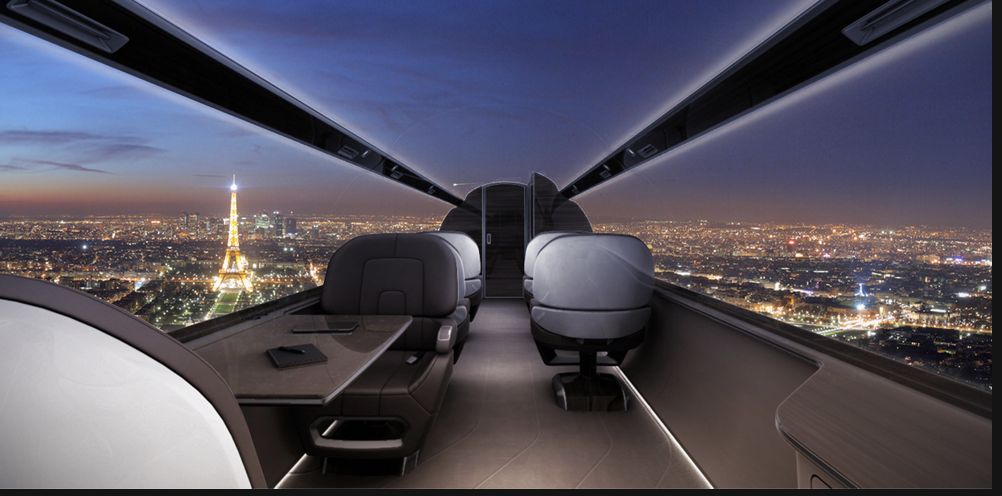
The IXION Windowless Business Jet Concept has no windows. Instead any scene
can be projected onto a high-res screen on the interior cabin walls and
ceiling. It could be the view from the outside of the plane or relaxing
scenes or business charts! The displays would be powered by Solar
panels on the jet’s exterior.

The design recently won the Exterior Design Concept category at the 2014 International Yacht & Aviation Awards for Paris-based company Technicon.


The advantages of removing windows include:
  • construction cost reductions
  • a lower weight leading to decreased fuel usage
  • increased flexibility for the inside layout of the plane
140816 exterior jet
Isaac Asimov, the late Science Fiction writer, in his book Caves of Steel
described windowless flying. As someone who loves gazing from the
window, his prediction filled me with dread. Air design up to now has
been about increaseing window size (for example Boeing with the 787)
 but with most passengers absorbed in kindles, seatback TVs, Ipads and
computers, today, do we need windows anymore?
Many airlines now have cameras which can send back the exterior view to a
screen. Is this IXION concept heralding a future step? Would passengers
take to it?


Would you fly a windowless plane?


 - Wild About Travel

Wednesday, August 27, 2014

Cheap Airplane Seats Shouldn't Recline at All

Cheap Airplane Seats Shouldn't Recline at All
Yesterday, we shared the amusing case of the cross-country trip that was diverted when two
passengers got in a battle over a reclining seat. But the real villain here isn't our travel-addled selves. It's that we still let airplane seats recline at all.

Yes, the story of two middle-aged adults grounding a plane because they couldn't agree to settle their dispute like reasonable humans is funny—ha ha! It sounds like the setup to a romantic comedy I would probably happily watch on an airplane. But here's something that's not funny at all: There's just not enough room for seats to recline any more.

The bottom line is that the days of affordable comfort in the skies—especially on domestic flights—are over. As airlines struggle to turn profits in the face of rising fuel costs, economy seats in planes keep getting smaller and smaller, with less and less legroom. Though many airlines persist in giving us the illusion that we're flying in comfort with amenities like seats that barely recline and flimsy "pillows" filled with straw, most of us can't really pay the premium that comfort actually costs.

Todays airplane rows are so tightly packed together that the act of reclining not only makes it impossible for the person behind you to enjoy basic liberties like using their laptop, reading a book, and eating food, it's also painful for anyone within barking distance of six feet tall. If you're reclining into someone just a tiny bit above average human height, chances are you're going to cause them extreme discomfort so that you might get a few inches of comfort.

You might argue that a few inches of comfort is what you deserve as a paying customer of an airline. You might be old enough to fondly remember a time when you could casually lounge into coach class, push your seat back with abandon, and fall into a deep slumber until 10 minutes before landing. That the world had this once might lead you to believe that you deserve this forever.

Not so! You deserve what you can pay for, and at the dirt cheap economy prices we've demanded, all we can afford is to be shoe-horned into a junky seat and shuttled from point A to point B while being served by a cranky lifer. Many budget airlines like Spirit have already seen the light, physically removing the reclining mechanisms from seats. And there's evidence to suggest that many airline passengers agree they'd be better off without reclining seats. The obvious exception to all of this is business and first, which still offers enough leg room that reclining is fine and good.

The rest of us, though, need to give it up already. We can avoid future battles in the skies and everyone will be a little happier, and ultimately a little more comfortable.

But give us the full can of soda, please. That's non-negotiable.

Tuesday, August 26, 2014

Updating the A380: the prospect of a neo version and what’s involved

Recent headlines and this column report that Airbus is considering
re-engining the popular A330 with GE Aviation GEnx or Rolls-Royce Trent
1000-TEN power plants. A New Engine Option and other changes would
improve the A330’s economy by an estimated 10% percent after offsets for
increased drag and weight.

But the A330 isn’t the only Airbus airplane being considered for new
engines made popular by the A320neo family. Tim Clark, president and
chief operating officer of Emirates Airlines, urged Airbus to improve
efficiency of the giant A380 with engine technology found in newer
generation aircraft.

How feasible is an A380neo? What are the technological issues? Would
there be enough of an economic gain? And is there a market for an
A380neo?

The A380 of today

The A380 has been hailed as a highly efficient airliner since it went
into service 2008, assuming the giant plane can be filled. But only six
years later, the first voices have been raised that this will not
continue to be the case should the continuous improvements that have
been flowing into the airframe not pick up speed.

The launch of the Boeing 777X also brought focus on the state of the
A380 come the latter part of this decade when the 777-9X enters flight
testing in advance of its planned 2020 entry-into-service. Tim Clark
expressed  that “it is time that the A380 gets an injection of the new
technology which is now becoming available for the A320/737 in the form
of GTF/LEAP and GE9X for the 777X. “

Before we look into what can be done short-to–mid-term to inject
improved efficiency, let’s establish the baseline as it exists today.
The A380 is considered by some the most efficient way of flying
passengers between two long haul points if there is enough of demand.
The competition today is the Boeing 777-300ER and 747-8i.  (Qantas
Airways is dropping some A380 flights that have 50% load factors,
demonstrating the aircraft is inefficient if the demand is
insufficient.)

Let’s assume we want to transport passengers between San Francisco
and Hong Kong, one of the longer flights which are made non-stop in both
directions. Going West, it takes a Cathay 777-300ER 15 hours and going
East, 12 hours, the difference being due to prevailing headwinds going
West. For our check, we will use the more demanding of these legs, which
then works out as the equivalent of flying 7,200nm. To compare the
three different aircraft in a fair way, we need to load them to the same
payload, in our case passengers with luggage. We will not consider
cargo in this initial analysis. The leg chosen is not one which allows
much weight for cargo, but cargo certainly belongs to a complete
analysis of an airplane and we will point out where it will affect any
conclusions.

When comparing the standard three-class seating numbers between the
OEMs, it is clear these are not made to the same standards of comfort.
Airbus has admitted that the A380 is too lightly loaded at 525
passengers. The 777-300ER at nine abreast and 365 seats is equipped with
a comfortable 18’’ economy class at 32’’ pitch but the business class
is modeled with a non-standard 48’’ pitch. The 747-8i at 467 seats is
not laid out to any comfort standards comparable to the other two. To
ensure an apples-to-apples comparison we have equipped all aircraft with
the same three-class cabin with a standard seating consisting of first
class at 81’’ pitch, business class at 60’’ pitch and economy class with
32’’ pitch. Seat widths are 37’’, 22’’ and 18’ respectively and the
ratios of the different premium seatings vs. economy are kept the same.
Here the aircraft are listed with the in-service year and with their
respective payload capabilities:

Click on all illustrations to enlarge.

A380 v 777 v 747-8 specs
Table 1

Today’s costs

Fuel constitutes about 50% of long-haul costs; therefore we will
focus on this main cost parameter for this comparison between the
aircraft. In the table below we have now added the trip fuel burn over
our chosen 15 hour flight. Since we compare aircraft of vastly different
sizes, our normal cost per aircraft mile comparison makes little sense.
We have kept the fuel cost per available seat mile and complemented
with the format that Lufthansa uses: litre consumed per passenger and
100km flown. (These figures represent nominal aircraft with our
standardized cabin. The figures therefore cannot be compared with the
Lufthansa published litre fuel/100km, which is for aircraft with their
specific seating):

A380 v 777 v 747-8 economics
Table 2

As can be seen, all aircraft are in the same fuel cost range with the
A380 having 5% worse fuel costs per seat than the 777-300ER but 3%
better than the 747-8i. The differences in direct operating costs are
augmented by the 300ER’s lower engine maintenance costs and the revenue
side has a superior cargo capability.  Why, then, does Emirates tout the
A380 as its premier aircraft? Because for an airline, an aircraft is
judged in part by the difference between Revenue per Available Seat Mile
(RASM) and Cost per Available Seat Mile (CASM). Emirates has passenger
load factors which are considerably higher for the A380 than other
aircraft. This more than compensates for any difference in fuel burn,
cargo capacity (cargo pays less well than passengers) and engine
maintenance cost. This is valid as long as the fuel consumed per seat
mile does not differ more than today.

If we look forward to the turn of the decade and introduce the 777-9X
into the table, it is clear why Tim Clark is now saying the A380 will
have to be updated come 2020. The new 777-9X will consume 20% less fuel
per seat then the -300ER, according to Boeing, and then the cost
equation will change.

A380 v 777 v 747-8 v 777x economics
Table 3

The 777-9X has a 13% better fuel consumption per seat then today’s
A380. Add to that its 27 empty LD3 positions once the baggage LD3s have
been loaded and the business case for a A380 is getting challenged.  It
shall be noted that we now have the economy section for the 777X at 10
abreast, which is below our 18’’ seat-width rule. Should we have kept
this rule, the per seat fuel difference would have been -8%. Given the
small comfort improvements that -9X brings for 10 abreast economy—an
increase of about one-half inch per seat, Boeing calculates—and the
likelihood that most airlines will fly it at 10 abreast, we therefore
show the upcoming threat to the A380 as a 10 abreast variant (already
nearly three quarters of the airlines today go 10 abreast for the
-300ER).

Updating the A380

As can be seen, the enhanced A380 should be available in a new
version before or around 2020. There are principally three ways Airbus
can prepare the A380 for the next decade:

  1. Rely on incremental improvements to engines and aerodynamics and make the cabin denser;
  2. Update to engines available before 2020, improve aerodynamics and make the cabin denser; or
  3. Update to engines available after 2020, improve aerodynamics and have more freedom with cabin density.
Of these improvements, we will discuss the aerodynamic improvements
and denser cabins first since these are common factors for all three
alternatives.

The A380 is a construction of a somewhat different shape compared to a
classical “wings with tube” airliner. This is a result of wanting to
transport up to 800 people in a vehicle which is constrained to a
maximum dimension of 80 meters by 80 meters for airport operations, the
famous 80 meter box. This forced Airbus to build the A380 with a two
stories fuselage and with a wing with an unusually low aspect ratio. At
7.8, it is well below the present state of the art, which is more like
9.0 (777-300ER) or 9.5 (787, A350). The drag due to weight (induced
drag) is therefore higher than normal. This is compensated by good
values for the normally dominant drag component, the drag due to size
(wetted area and form drag). In fact, the figures for drag show the
reverse trend compared to normal airliners with drag due to weight
dominating with 50% at average cruise weight and the drag due to size
down at 40%. Thus the A380 compensates a restricted wing with good
packaging of the passenger compartment. Its short two-story passenger
compartment and elaborate main landing gear restricts its cargo
capability however, something is shares with the 747-8i.

Aerodynamic improvement to reduce induced drag is therefore a primary
goal for any A380 update. It will take the form of wingtip treatments
to increase the effective span. As the wing is already at maximum
possible span and was not designed for folding wing-tips, the remaining
option is large winglets that spread in the vertical domain. These can
take the form of single blade (Sharklets) or multi-blade (Scimitar or
perhaps “Sharkfins” in Airbus parlance) devices that alleviate induced
drag as a function of their physical size. We have assumed winglets of
4m size in our analysis, which enhance the efficiency by 3.5% over the
present wing fences on long-haul flights.

To get more revenue generating passengers on board, Airbus is
studying 11 abreast seating on certain parts of the A380 main deck. This
will increase the coach capacity by about 30-40 seats without
compromising the 18’’ seat width standard, according to the company. We
will include such a denser cabin when we compare future A380 variants to
today’s aircraft.

New engines

We will now examine the perhaps most important component of an
efficiency improvement program for the A380, the engines (see table
below for a list of all candidates):

A380neo Engine Specs
Table 4

First the incremental improvement of the existing Trent T900 and
EA7200. The T900 has historically trailed the EA7200 by about 1% in
specific fuel consumption. The present T900EP is said to close that gap
and Rolls Royce have another improvement package in the works which will
add another 0.8%, T900EP2. The size of these improvements are typical,
about 1% every three years; thus we would expect to see a total of 2%
improvement from now to 2020.

A second alternative is to take an existing engine from a later
generation. Suitable engines in thrust and weight would be 787 engines,
the GE GEnx-1 and Rolls Royce T1000. These deliver an improvement of
4%-5% over the present A380 engines in the variants that are being
developed for the 787-10. With these engines being certified in 2015,
theoretically an A380neo can see an EIS in 2016, sooner than a new
engine could be engineered onto the A380. A more likely A380neo target
EIS would be 2018, the wish date of Emirates for an upgrade (the airline
starts to take delivery of the new batch of 50 then). The 787 engines
are some 250kg lighter then the lightest A380 engine (T1000) and as they
have less fan diameter their nacelles will be slightly smaller and
lighter.

A third alternative would be a totally new development based on e.g.
RR RB3039 or a PW GTF. Such engines offer an additional 6%-7% efficiency
improvement over a 787 engine derivative. Their drawback would be
higher weight and drag due to their larger fans and their 60:1 pressure
ratios. Another drawback is that they will not be available until after
2021. Additionally there is the question whether there is a business
case for an entirely new engine serving only the A380, a niche aircraft
for which the 20 year market demand before or after a neo is a matter of
diverse opinions.

The different engine alternatives are shown in the table where we
have also included the A330 engines as the thrust requirement for an
A330neo is similar to the A380 and there is a certain probability that
development of an engine variant and nacelle would be shared between the
two programs (Table 4).

There is a lack of an entry from PW in the table, mainly because it
has not publicly presented the outline of an alternative. For a 2021
time frame, PW could well be in the running. The question would then be
with what programs could they share the development costs as a re-engine
of the A380 would potentially only represent a small number of engines
for PW. It can also be seen in the table that GEnx-1 somewhat trails the
T1000-TEN in efficiency, mainly because Rolls Royce have decided to do
three updates of the T1000 and GE have only announced to be doing two.
It would be no big problem for GE to inject some LEAP technology into
the GEnx-1 for an A380/330 neo project and close that gap.

Much has been written about the work involved in converting 787
engines to bleed variants. In fact these are bleed engines. These
engines put out compressor bleed air to deice the nacelle inlet and they
use compressor bleed ports to correct compressor handling problems at
low RPM. In essence bleed variants are rescheduled variants of the
existing engines, not a big redesign as many speculate.

Which way to go

If we put the three alternatives on the A380 and list them side by
side with the present and future Boeing competitor we will get the
following table:

A380neo v A380ceo v Boeing
Table 5

There are a number of conclusions that can be drawn:

A380-PIP

Airbus can almost achieve Emirates wish for a 10% improvement in
efficiency per seat until 2018 with a combination of 11 abreast economy
cabin on the main floor, improved aerodynamics and incrementally
improved engines. This variant would beat the 777-300ER in per seat
efficiency as long as a 300ER runs at nine abreast. If we change this to
10 abreast, the 300ER passes the A380-PIP with 3%. It shall once again
be pointed out that we only look at passenger capability here.
Under-floor cargo is the 777’s strong point and it will improve the 777s
earnings in a real situation. The A380-PIP would not match a 777-9X in
per seat efficiency but it would be within 4%, both using denser cabins
than today. Once again higher cargo capability will improve a 777X
business case, especially if seasonal fluctuations reduce the A380 load
factors over, for example, winter months.

A380neo16

With an additional upgrade to 787 engines we gain another 5% in trip
fuel burn and therefore also seat fuel burn as all improved variants
share the denser cabin. This variant is fractionally more efficient than
a 777-9X and would be attractive for routes where one can fill an A380
also after 2020. There is no projected aircraft that can reach the per
seat economics of a well loaded A380neo16, and this is what Emirates
route planners have found.

A380neo21

If the engine upgrade of the A380 would wait for Rolls Royce or PW
engines of the 777X generation (GE might be restricted by its 777X
engagement, see A350 engine sharing problematic below), it would gain
another 5% in fuel economy over the A380neo16 variant. While this is
attractive it has more complicated project and business model
implications. The A380 is not a high volume program and it is not
projected to be for the 20 years remaining after a neo. It would thus at
best create a market for an engine program of some 2,000 engines, or
roughly 400-500 airplanes, plus spares. Should this be divided between
two manufacturers like today, we talk about 1,000+ engines per engine
program. Given the uncertainty of A380 sales numbers this is not a
viable business case for a new engine development; costs would have to
be shared with some other platform.

Finally:

Sharing with an A330neo is ideal as the A330 and A380 have the same
thrust requirements. It is doubtful an A330neo can wait until 2021,
however, due to market pressure—EIS is being discussed for 2018. This
leaves the A350 as a partner program for an A380neo21. Here, the thrust
and therefore engine size requirements do not fit well. A new engine for
A350 should ideally cover 80-105klbf as an A350-1100 is a likely
development. Detuning an engine designed for 100klbf by 25% results in a
substantial loss of efficiency, both in terms of specific fuel
consumption and size/weight. The A350 is also constrained as to which
models GE and PW can be allowed to bid for; only Rolls Royce would have
access to all variants due to their A350-1000 exclusivity. In summary an
A380neo21 is less straight forward then an A380neo16 with higher
investments and risks for the engine manufacturers.

Finally, we note that none of these analyses consider the prospect of
a stretched A380, the -900. Airbus does not seem in a hurry to define
such a development. We therefore focused on updates to the existing -800
model.

The best Return on Investment for the engine makers is a common
engine on the A330neo and the A380neo, and the timeline desired by
Airbus for the A330neo all but dictates a choice of the GEnx or Trent
1000 TEN, with the resulting application to the A380neo.

Our data, and analyses by customers who have evaluated the 777-9 vs
the A380 (and 747-8i), indicate a 10-abreast 777-9X has better seat mile
costs then the much larger, current A380 and the 747-8i. Thus, if
Airbus is going to maintain an economic advantage with its four engined
airplane vs the twin-engine 777-9, an A380neo is a must.

By Leeham Co EU

 | Leeham News and Comment

The Super Twin Battle: A350-1000 versus 777-9X

With the forthcoming launch of the 777-9 at the Dubai Air Show next
month, the battle between the A350-1000 and 777-9 will be officially on,
with two very different aircraft competing for the same market.  While
there is discussion of another stretch to the A350 program to provide
comparable capacity to the larger 777-9, we can compare today’s aircraft
and examine their relative economics based on manufacturer projections
and Piano models based on preliminary specifications.

The A350-1000

The A350-1000 is the largest of 3 models in the A350 family, with 350
seats in a typical three class configuration, with an 8,400 nautical
mile range.  The A350 features carbon fiber composite structure and
wings, and at 53% composites will have slightly more of the aircraft
made of this material than the Boeing 787-9, which is 50% composites. 
It features new technology Trent XWB engines from Rolls Royce with
state-of-the art fuel efficiency, advanced aerodynamics, and state of
the art systems.

The 777-9X

The 777-9 is a stretched version of the current 777-300ER with a new
engine and new wing, along with other enhancements, to create an updated
version of the 777, which delivered its 1,000th example earlier this
year.  The 777-9X will feature an aluminum alloy fuselage with a carbon
fiber composite wing, and new technology GE9X engines that are derived
from the GE90 and GEnx families.  The wingspan for the 777-9 will be
longer than any Boeing aircraft, and will include folding wingtips to
enable the aircraft to utilize current gate positions at airports, as
otherwise the new model would require gates typically used for A380
operations (which are currently quite limited at congested airports.)

Comparing the Aircraft

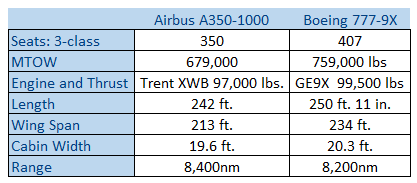
The following table compares the two aircraft on several key statistics, based on preliminary data prior to the 777-9X launch:

The A350 cabin width is larger than the 787 and smaller than the
777X.  The result is that a typical configuration in economy would be 9
abreast at 17 inch seat width for the 787, 9 abreast at 18 inch seat
width for the A350, and 10 abreast using 17 inch seat width for the
777.  While the 777 is currently offered in 9 and 10 abreast seating,
recent orders have trended to 10 abreast seating as airline seek to
maximize seat-mile costs.

10_28_2013_11_55_45_AM
COMPARATIVE ECONOMICS

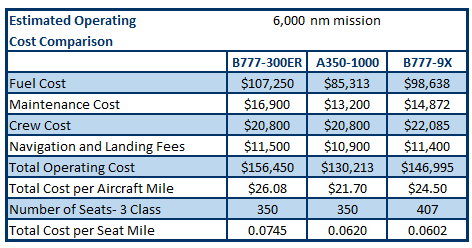
Both manufacturers are claiming class leading economics for their
airplanes, but in reality, they are very, very close.  The 777-9 holds a
16% advantage in capacity, which directly impacts seat-mile costs, but
the A350-1000 will have lower trip costs than its larger competitor. 
Our estimates for a 6,000NM trip, based on preliminary specifications
from airframe manufacturers, our own economic modeling, and data gleaned
from airlines, are as follows:


10_28_2013_11_54_53_AM
With
very comparable seat-mile costs, the A350-1000 and 777-9X will be
competitive, and it will come down to how many seats an airline believes
it can fill.  For those that can fill 400 seats, the 777-9 looks like a
good alternative, for those that prefer a lower risk, the 350 seat
A350-1000 is the right airplane.
The key question, as the OEMs continue to one up each other, is
whether an A350-1100 stretch will be built. The A350-1100 would be an
all new technology aircraft competing with a highly modified but
derivative model, and should have both lower aircraft mile costs and
lower seat mile costs than the 777-9.  A stretched A350 would also help
to bridge the large gap in size between A350-1000 and A380-800.

We believe the A350-1100 will become a competitive necessity for
Airbus.  With the A350-1000 due for EIS in 2017, and the 777-9X due in
late 2019 or 2020, there is still time for Airbus to bring out an
additional model in time to check the size advantage for Boeing.  As
airlines are looking to larger twins to replace 747-400 with aircraft of
similar capacity, the time is right for these “super-twins” in the
marketplace.

 -AirInsight

Sunday, August 24, 2014

Three-Class Planes Are an Unnecessary Luxury in Air Travel Today

American Airlines

Three-class cabins on international jets, once a hallmark of passenger pampering, are dwindling at the world’s largest carrier.

Waning customer interest in the costliest tickets prompted American Airlines
to drop first class as it adds seats to its 47 long-haul Boeing Co.
777-200s. The aircraft will get new lie- flat business seats — plusher
than coach, but lacking first- class flourishes such as pajamas,
slippers and an amuse bouche.

“We’re responding to what demand is,” Casey Norton, an American
spokesman, said yesterday. “We’ve looked at what the demand level is for
business and also what we need in the main cabin as well. That’s where
we think we’ve hit the sweet spot.”

The changes will leave American with international three- class
service — first, business and economy — only on the 777-300ER, the
carrier’s biggest aircraft. Fort Worth, Texas- based American has 14 of
those planes flying on some of its most-lucrative overseas routes, such
as Miami-Sao Paulo, while using the 777-200 for city pairs including
Chicago-Beijing.

Upgrading business cabins is a bet on making money by selling more of
those premium seats than costlier first-class fares. A refundable,
round-trip first-class ticket for a Chicago-Beijing trip departing
tomorrow costs as much as $37,948, according to American’s website.
That’s almost double the price of a comparable business-class seat, and
four times as much as a non-refundable business ticket.

Refitting Begins

While plans for upgrades to American’s international fleet first were
announced in May 2012 — when the airline was in bankruptcy and before
the 2013 merger with US Airways Group — the first of the 777-200s is
only now being refitted.

Scaling back three-cabin service pushes American closer to other
global airlines that have abandoned or limited first-class seating. With
lie-flat beds now standard in business cabins, carriers such as
Atlanta-based Delta Air Lines Inc. have opted to make that level their most-exclusive offering.

United Airlines, the world’s second-biggest carrier, still has
three-class jets on some routes. American has three cabins on one
domestic plane type: The Airbus A321T configured for cross-country
flights between New York’s Kennedy airport and Los Angeles, and between
Kennedy and San Francisco.

American initially will boost seating on 22 of the 777-200s to 260
from 247, completing that work in 2015’s third quarter. In the middle of
next year, American will start taking all the planes to 289 seats. That
program will conclude in late 2016, Norton said.

The pitch, or distance between one point on a seat to the same point
on the next row, won’t change in the retrofits, Norton said.

Once all the work is done, the 777-200 will have 37 business-class
seats that take up more room than the current version. Each will have
aisle access and will convert to a 6- foot, 4 1/2-inch (1.9-meter)
life-flat bed. Main-cabin seats will increase to 252 from 194. The
larger 777-300ER has eight first-class seats, 52 in business and 250 in
the main cabin, according to the SeatGuru travel website.

“That’s why we have different fleet types,” said Jenna Arnold, an
American spokeswoman. “The -300s are in markets where customers want,
and will pay for, first-class cabins.”

With assistance from Benedikt Kammel in Berlin.
 – Skift

Sunday, August 17, 2014

Boeing 747 On Deathwatch: How Boeing’s New 777X Will Kill Its Jumbo Jet Predecessor, Once The Queen Of The Skies

Ask any passenger at any airport in the world: “Can you recognize a
Boeing 747?” Chances are, even casual flyers will say, “Yes.” With its
unmistakable hump and graceful lines, the Jumbo Jet -- so famous it
earned its own nickname -- has been a familiar sight around the globe
since it first flew in 1969.

http://upload.wikimedia.org/wikipedia/commons/8/8f/Pan_Am_Boeing_747_at_Zurich_Airport_in_May_1985.jpgIt was, for decades, the biggest airplane in the world. It was the
star of blockbuster movies, such as “Air Force One” and entries in the
“Airport” series. It was the Queen of the Skies, as enthusiasts called
it, the flagship of dozens of airlines, on every continent except
Antarctica.

All that is about to change.

The Jumbo Jet is no match for a world of high oil prices and new,
fuel-efficient airplanes that transport almost as many people, but with a
much smaller fuel bill. Ironically, the nail in the coffin may come
from the Boeing Co. (NYSE:BA) itself, the outfit that 40 years ago bet
the farm, and won hugely, on the success of the 747 -- and now is about
to send it into commercial oblivion with its newest product, the 777X.

[[nid:1236669]]

Chicago-based Boeing (NYSE:BA) has not officially launched the new,
stretched version of its 777, but it appears it will do so very soon:
Its board may already have given the go-ahead to the company’s sales
team to begin offering the new machine to airlines.

“We don’t comment on board meetings, but we are taking the next
steps” toward giving the 777X its debut, Boeing representative Doug
Alder said. “We made a lot of great progress in our development work,
and we began to discuss the additional technical, pricing and schedule
details with our customers, and are targeting entry into service at the
end of the decade.”

The 777-9X variant would fly 405 passengers as far as 8,100 nautical
miles or 15,000 kilometers, according to several reports, which, Boeing
representative Karen Crabtree said, “are in the ballpark” of what the
new plane would do. The 747’s latest version, the 747-8I
(Intercontinental), typically flies about 470 people over the same
maximum distance, but with a key difference: It has four engines, not
two. And that hurts seat-mile cost, the all-important metric that
measures how much fuel it takes to fly one passenger one mile.

So airlines are increasingly choosing the 777, both the current 300ER
model seating about 350 people, and the future, slightly larger 9X
version. With the Platts jet-fuel price having risen about 211 percent
since 2000, according to the International Air Transport Association, the trade organization representing the world’s airlines, the twin-engined 777 is cleaning up. Boeing reported it has logged more than 1,400 orders since its debut in 1995, almost as many as the 747 has in its whole career.

That leaves the 747-8 in the lurch. Boeing has sold only 101 of the
planes since it was announced in 2005. And most of these orders were for
freighters -- only about one-quarter of them were for the 8I passenger
version: The flagship unit of Germany’s Deutsche Lufthansa AG (FRA:LHA)
is the sole airline to fly it today.

Boeing has a mere 59 unfilled orders for the jet. At the recently
reduced production rate of 1.75 planes per month, the end of the line
for the Queen of the Skies will come in less than three years, assuming
no new orders come in.

[[nid:1236663]]

Boeing isn’t really killing the 747, to be sure. In fact, it makes
quite clear that it’s here to stay and it’s still being improved. “We
are not shifting away any focus on the 747-8,” Boeing representative
Joanna Pickup said. The idea is to sell it as a bigger, different
machine from the 777X. “They serve different markets. Boeing’s product
strategy is to provide customers maximum flexibility for the capacity
they want.”

Boeing forecasts about 800 orders over the next 20 years for
so-called very large aircraft, which means the 747-8 and the only other
game in town, the even bigger but not much more successful A380 from the
Airbus unit of Europe’s EADS NV (EPA:EAD): Airbus
has booked 262 orders for the A380 since its inception. The Boeing
forecast of 800 orders for VLA seems like a lot, but it’s only 6 percent
of the total expected size of the commercial airplane market.

“Market forecasts say [Boeing] never valued too much the very large
aircraft sector,” said Gregory Alegi, who at Luiss University in Rome is
an adjunct professor of history of the Americas in the political
science department and teaches aviation management in the business
school. “Given the forecasts, they have decided long ago to just update
the old 747. It’s a niche market that they want to be in, but one they
don’t want to invest in.”

Alegi added, “It’s lucrative niche for sure, thanks to prices” that Boeing notes surpass $350 million per aircraft, but a niche nonetheless.

'Mad Men'-Era Glamour

For the Queen of the Skies, it’s been a great run. The 747 entered
commercial service with Pan American in 1970, and Boeing says that
Jumbos have flown 3.5 billion people since then, the equivalent of
one-half of the world’s population.

For decades, the 747 monopolized the world’s long-range, high-traffic
air routes, as well as the imaginations of enthusiasts everywhere.

[[nid:1236661]]

“It has a magical aura,” said Guillaume de Syon, a history professor
at Albright College in Reading, Pa., who specializes in aviation. He got
the aviation bug, he recalled, when a Swissair pilot in his native
Switzerland gave him a tour of a Jumbo cockpit.

“Swissair bought two 747s, and just went to New York. One was the
prestigious United Nations route from Geneva, the other the cash cow
from Zurich,” de Syon said. “You could set your clock by when it took
off from Geneva with its distinctive rumble. It was a social practice,”
one that highlighted the mystique of the giant airplane.

“The bump in the fuselage made it an icon. It was the first wide-body
passenger aircraft, which gave this notion of space” and allowed
airlines to sell it much like a luxury ship, with posh lounges on the
upper deck. “You can see them in museums and it feels very old, very
‘Mad Men,’” de Syon said.

The paradox of the 747 is that, while evoking the bygone era of
passengers in suits and fedoras who smoked on airplanes, it also made
air travel affordable for the masses. Airlines needed to fill its 400
seats, more than double the jets of the 1960s that it superseded, and
often offered sharply discounted ticket prices to do so.

Big, Safe, Forgiving -- And Pretty  

“It democratized long-range travel,” said Carlo Galiotto, who flew
747s for Alitalia as both first officer and captain. “Until the 1980s,
our traffic was made up of immigrants who came back to visit Italy, or
very well-off people. But the 747 made travel possible for people who
just wanted to, say, spend four days in New York.”

The Jumbo was also a pilot’s dream, recalled Galiotto, who flew the
now-retired 200 series, the last one to feature a bewildering deluge of
classic round dials on the flight deck instead of the computer screens
in today’s 747s.

[[nid:1236667]]

“It was like a forgiving father. You could make mistakes. It was so
well-built, so massive and with redundant systems, that it would shrug
off pilot errors. And if you lost an engine, it didn’t care a bit,”
Galiotto said. “Losing an engine on any other plane would have been an
emergency. On that one, it was just an anomaly.”

Galiotto added: “Passengers felt safer, too. Despite its great
inertia, it felt more stable. It had ample space for cabin personnel,
too. Life on board was less neurotic for everybody.”

David Powell, who flew both 747s and 777s for United Continental
Holdings' (NYSE:UAL) United Air Lines and is now dean of the Western
Michigan University College of Aviation in Kalamazoo, took a diplomatic
stance on whether he prefers one or the other. “I’ve got friends on the
777 -- it’s a wonderful airplane,” he said. But the 747’s extra engines
make it safer. “If I am flying across the Pacific on a 747 and lose an
engine, I’ve got three more. On the 777, that never happened, but they
came close.”

Powell said of the 747: “It really was the queen of the fleet. Four
engines, a beautiful airplane. The upper deck was unique, and for a
pilot it was nice being up there.” He conceded, “But it’s all about the
cost.”

A Rare Bird

Back in the day when most flag-carrier airlines were owned by
governments and aviation was a matter of national prestige, pilots
weren’t the only ones in love with the Queen. To airline-company
managers, the 747 was a must-have.

"The airlines had to get them, even if it made no sense
economically,” said de Syon, Albright College’s aviation expert. “Small
airlines from small countries flew 747s into [New York’s] JFK -- it was
an incredible assembly."

Indeed, during the Jumbo Jet’s heyday in the 1970s and 1980s, it was
possible to see more than 30 regularly scheduled 747s at New York’s
biggest airport. They came from every continent, from Australia’s Qantas
Airways to Aer Lingus in Ireland. Now, only about five airlines fly
Jumbos to the city.

[[nid:1236665]]

Still, there’s at least one very prestigious job the humpbacked giant
may continue doing for many years: transporting the President of the
United States. Since 1990, the U.S. Air Force has used two highly
modified 747s as Air Force One, as the planes are called when the
commander-in-chief is on board. In Air Force service, they are known as
VC-25A, and despite being flown much less than commercial Jumbos, the
planes are getting old, and the Pentagon is looking for replacements.

Boeing’s Pickup would not comment on whether the 747-8 is in the
running, saying simply, “We are working with the customer to understand
the requirements.” But it’s hard to imagine the American president being
carried around the world in anything other than the most prestigious
American airplane. The Europeans may propose their A380, but it’s a safe
bet that the winner would be Boeing’s product.

And for that reason, if nothing else, the last icon of the golden age
of American supremacy in the skies may not ever go away completely.

[[nid:1236659]]

Tuesday, July 29, 2014

Malaysia Airlines Mulls Name Change


Regardless on how accountable one might hold Malaysia Airlines
for the two tragedies of the past six months, there's no question the
airline's brand and identity have been considerably tarnished.


It's way too early to know if there will be any long-term impact on
future business success, but it appears MH won't be waiting around to
find out. In a media release,
it announced that it has already begun considering a new brand
identity, including a new name, to go along with a restructuring of
routes. The Malaysian Government, which is the majority shareholder of
the airline, said it would all be in an effort to draw new investors and
rebuild.

There was no indication of whether the changes would be subtle or
severe, and we would imagine the decision won't be made until the dust
settles and the full consequences of the disasters are able to be felt.
As a result, we don't expect to see a new name any time soon, but just
hearing that it's on the table for discussion is very interesting. We
typically get pretty excited when new livery and designs roll out, but
in this case, it obviously won't be an occasion to celebrate.


[Photo: Aljazeera]